
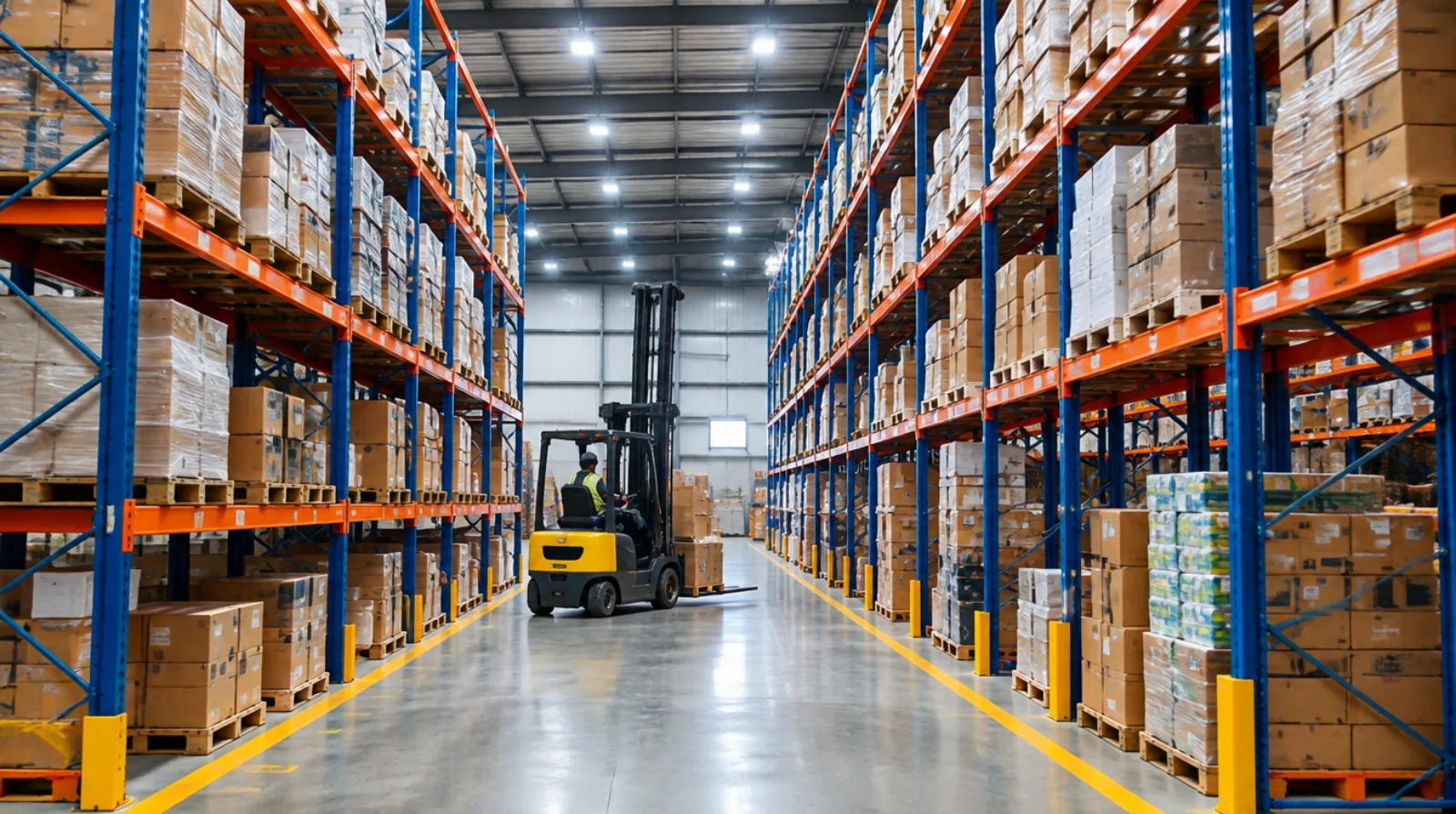
How to Choose Warehouse Racking for Your Load, Space and Forklift
To choose warehouse racking, start with three facts: what you store and how heavy it is, how much floor space and clear height you have, and what forklift or stacker you use. Most Kampala warehouses with many different products are best served by selective pallet racking, because every pallet is reachable. If you hold large volumes of a few products, drive-in or drive-through racking can almost double your storage in the same space.
This guide walks through each decision and the racking type it points to.
Step 1: What are you storing?
- Pallets of goods (beverages, cement, FMCG, building materials): pallet racking of some kind.
- Cartons and loose items picked by hand (spares, stationery, pharmaceuticals): Industrial Shelving MEK-3154, adjustable to any height and rated up to 3,000 kg per shelf.
- Long items (pipes, steel sections, timber, rolls of material): Cantilever Racking MEK-3162, which has no front uprights in the way.
- Files and archives in a small room: Mobile Racking MEK-3164, which moves on rails and opens an aisle only where you need it.
Also note the heaviest pallet you will store and its size. Racking is designed around the load, so this number drives everything else.
Step 2: How many products, and how fast do they move?
This is the question that decides between selective and high-density racking.
- Many different products (SKUs), each with a few pallets: you need to reach any pallet at any time. Choose selective Pallet Racking MEK-3153.
- A few products in large volumes: you can store pallets deep in lanes. Choose Drive-In Racking MEK-3160 (last in, first out) or Drive-Through Racking MEK-3161 (first in, first out, for goods with expiry dates).
Step 3: How much space and height do you have?
Measure the clear height under the lowest roof beam, light or sprinkler, not the height to the roof sheets. Then check where columns, doors and loading bays sit, because they set where rack runs and aisles can go.
- Under about 8 m clear height: selective or high-density pallet racking.
- High-bay buildings above 8 m: VNA Racking cuts aisle space by at least 40% while keeping every pallet reachable.
Step 4: What forklift will you use?
Your truck sets the aisle width and the top beam height.
| Truck | Aisle needed | Best paired with |
|---|---|---|
| Hand pallet truck | Ground level only | Floor storage or bottom beam level |
| Counterbalance forklift | Widest aisles | Selective, drive-in and drive-through racking |
| Reach truck | Narrower aisles | Selective racking in tighter buildings |
| VNA turret truck | Very narrow aisles | VNA racking above 8 m |
Check the truck’s maximum lift height and its rated capacity at that height. A truck that lifts 1.5 tonnes at 3 m may lift much less at 6 m.
Which racking type fits your warehouse?
| Racking type | Best for | Space use | Access to pallets |
|---|---|---|---|
| Selective pallet racking | Many SKUs, mixed stock | Standard | Every pallet, directly |
| Drive-in | Large volumes of few SKUs | Almost twice standard | Last in, first out |
| Drive-through | Large volumes with expiry dates | Almost twice standard | First in, first out |
| VNA | High-bay buildings above 8 m | Aisles at least 40% narrower | Every pallet, with a VNA truck |
| Mobile racking | Archives, small rooms | Up to 90% more than fixed racking | One aisle opened at a time |
| Cantilever | Long and bulky items | Depends on stock length | Every arm, from the front |
MEK’s drive-in and drive-through systems reach up to 10 m high and carry up to 1,500 kg per pallet.
Step 5: Plan for safety from day one
- Mark the safe working load on every rack run and never exceed it.
- Fit column guards at aisle ends and anchor the uprights to a sound concrete floor.
- Keep the layout and load signs updated when stock changes.
- Inspect for damaged uprights and beams regularly, and unload a damaged bay before it is repaired.
Get a layout designed for your building
MEK Uganda designs racking around your actual building and stock, not a standard drawing. Through our Warehouse & Storage System Design service, we plan layout, load calculations and rack dimensions, then manufacture, deliver and install across Uganda and East and Central Africa. MEK has built steel products since 1921. Browse the full Material Handling range.
Frequently Asked Questions
What is the most common type of warehouse racking?
Selective pallet racking. Every pallet can be reached directly by forklift, which suits warehouses holding many different products.
How much weight can pallet racking hold?
It depends on the design. Racking is built around your heaviest pallet and the number of beam levels. MEK's drive-in and drive-through systems carry up to 1,500 kg per pallet and reach up to 10 m high.
What is the difference between drive-in and drive-through racking?
Drive-in racking is loaded and unloaded from the same side, so the last pallet in is the first out. Drive-through racking has access from both ends, so the first pallet in is the first out, which suits goods with expiry dates.
Do I need a special forklift for VNA racking?
Yes. VNA racking needs a dedicated very narrow aisle truck, and it suits high-bay warehouses above 8 m.
Can you design the layout for my warehouse?
Yes. MEK Uganda plans the layout and load calculations for your building and stock, then manufactures, delivers and installs the racking.
Planning a warehouse layout?
Send your warehouse size, clear height, pallet weight and forklift type to MEK Uganda and we will propose a racking layout.