
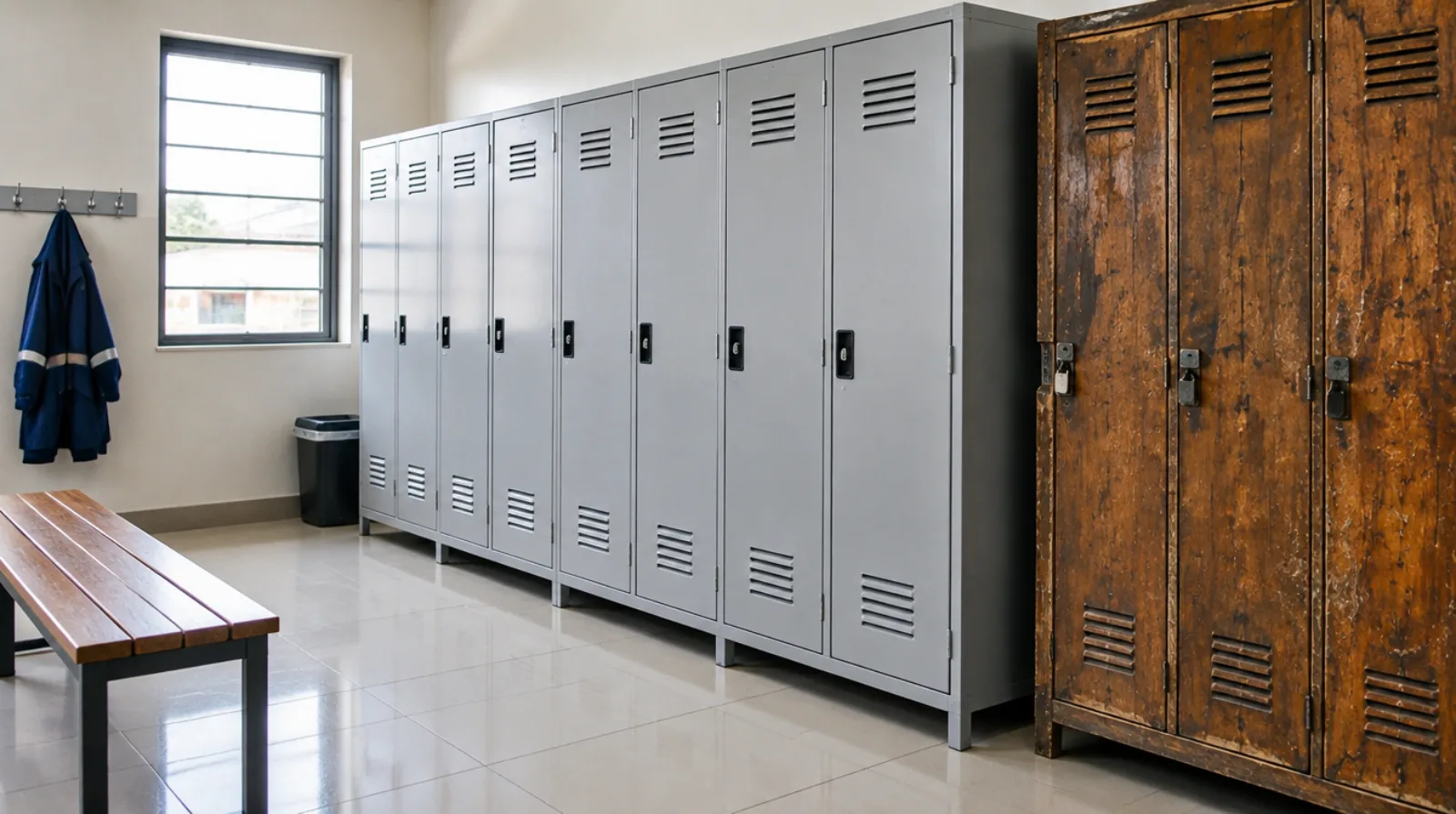
Steel Lockers vs Wooden Lockers: Which Lasts Longer in Ugandan Workplaces?
For factories, schools, hospitals and busy offices in Uganda, steel lockers last longer than wooden ones. Steel doesn’t swell in humid weather, isn’t eaten by termites, and can be wiped down and disinfected. Wooden lockers can suit a low-traffic office or executive changing room where looks matter most, but in shared, heavy-use spaces they usually need repair or replacement much sooner.
Below we compare the two on the points that matter to facilities managers, school bursars and HR teams, and explain how to size a steel locker order.
How do steel and wooden lockers compare?
| What matters | Steel lockers | Wooden lockers |
|---|---|---|
| Humidity and rainy seasons | Painted or powder-coated mild steel; doesn’t swell, warp or stick | Can swell and warp, so doors stick and hinges loosen |
| Termites and pests | Not affected | Vulnerable unless treated and maintained |
| Hygiene | Smooth surfaces wipe clean; raised feet let cleaners reach underneath | Porous surfaces hold moisture and odours |
| Security | Steel doors with key, digital or RFID locks | Easier to force; locks loosen as wood wears |
| Ventilation | Louvres on every door | Usually solid doors, so damp clothes stay damp |
| Capacity per unit | 1 to 18 compartments in one unit | Usually 1 to 4 compartments |
| Fire | Steel doesn’t burn | Combustible |
| Repairs | Replace a lock or a door, not the unit | Damage often means replacing the whole locker |
Why do wooden lockers wear out faster in Uganda?
Kampala’s two rainy seasons and the heat of factory floors are hard on timber and chipboard. Moisture gets into joints and edges, doors swell and stop closing properly, and once a lock no longer lines up the locker stops being secure. Add termites and the daily knocks of a changing room, and many wooden lockers need major repairs within a few years.
Steel lockers avoid these problems because the material itself doesn’t absorb water. A good paint or powder-coat finish protects it from rust, and the feet keep the base off wet floors.
Which steel locker fits your building?
- Factories, warehouses and large changing rooms: multi-compartment units, up to 18 per unit, so each worker gets a secure space without taking up much floor area. See Steel Staff Locker.
- Offices, banks and hospitals: 2, 4 or 6 compartment units 84 inches tall, with room for bags, uniforms and coats.
- Schools, colleges and hostels: 9-compartment Student Lockers sized for books, a backpack or a laptop, with a name card frame on each door.
- Gyms, pools and hotels: Smart RFID Lockers that open with a card, fob or wristband, so there are no keys to lose. Swimming pool versions use waterproof locks.
Key, digital or RFID lock: which should you choose?
- Key locks are the simplest and cheapest to maintain. They suit small teams where each person keeps their own locker.
- Digital (code) locks remove keys altogether and work well where lockers are shared between shifts.
- RFID locks let staff or students use the ID cards they already carry. With central software, administrators can set who opens which locker and see an audit trail of when each was opened.
How many lockers do you need?
Start with your total headcount, including shift workers who share a changing room. Then decide how much each person needs to store: a bag only, or a uniform and coat as well. As a rule of thumb:
- Bag and personal items: 4 to 6 compartments per unit.
- Uniforms and coats: 1 to 2 compartments per unit, so there is room to hang clothes.
- Tight floor space and many staff: units with up to 18 compartments.
Share your headcount and changing room size with MEK Uganda, and we’ll recommend the number of units and the layout.
When does a wooden locker still make sense?
In a quiet executive office or a boutique hotel where the lockers are part of the interior design, wood can be the right choice. Wherever lockers take daily wear, get wet or need cleaning, steel gives you more years of service for the same space.
Built in steel since 1921
MEK has manufactured steel products since 1921. MEK Uganda’s lockers are made from prime mild steel to the compartment count, height and lock type you need, and we deliver across Uganda and to all East and Central African countries. Browse the full Industrial Furniture range or ask our team about your project.
Frequently Asked Questions
Do steel lockers rust in humid weather?
Not when they are properly finished. MEK Uganda's lockers are made from prime mild steel with a paint or powder-coat finish, and stand on 4-inch feet so the base stays off wet floors.
How many compartments can one steel locker unit have?
From a single compartment up to 18 in one unit. Standard units are 84 inches tall and 18 inches deep, in 12, 24 or 36 inch widths.
Can lockers open with staff ID cards?
Yes. Smart RFID lockers can work with existing staff or student ID cards, as well as cards, fobs and wristbands, and keep an audit trail of who opened which locker.
Do you deliver lockers outside Kampala?
Yes. MEK Uganda delivers across Uganda and to all East and Central African countries, including Kenya, Tanzania, Rwanda, South Sudan and the DR Congo.
Planning lockers for a factory, school or hospital?
Send your headcount and room size to MEK Uganda and we will recommend the right units and layout.