
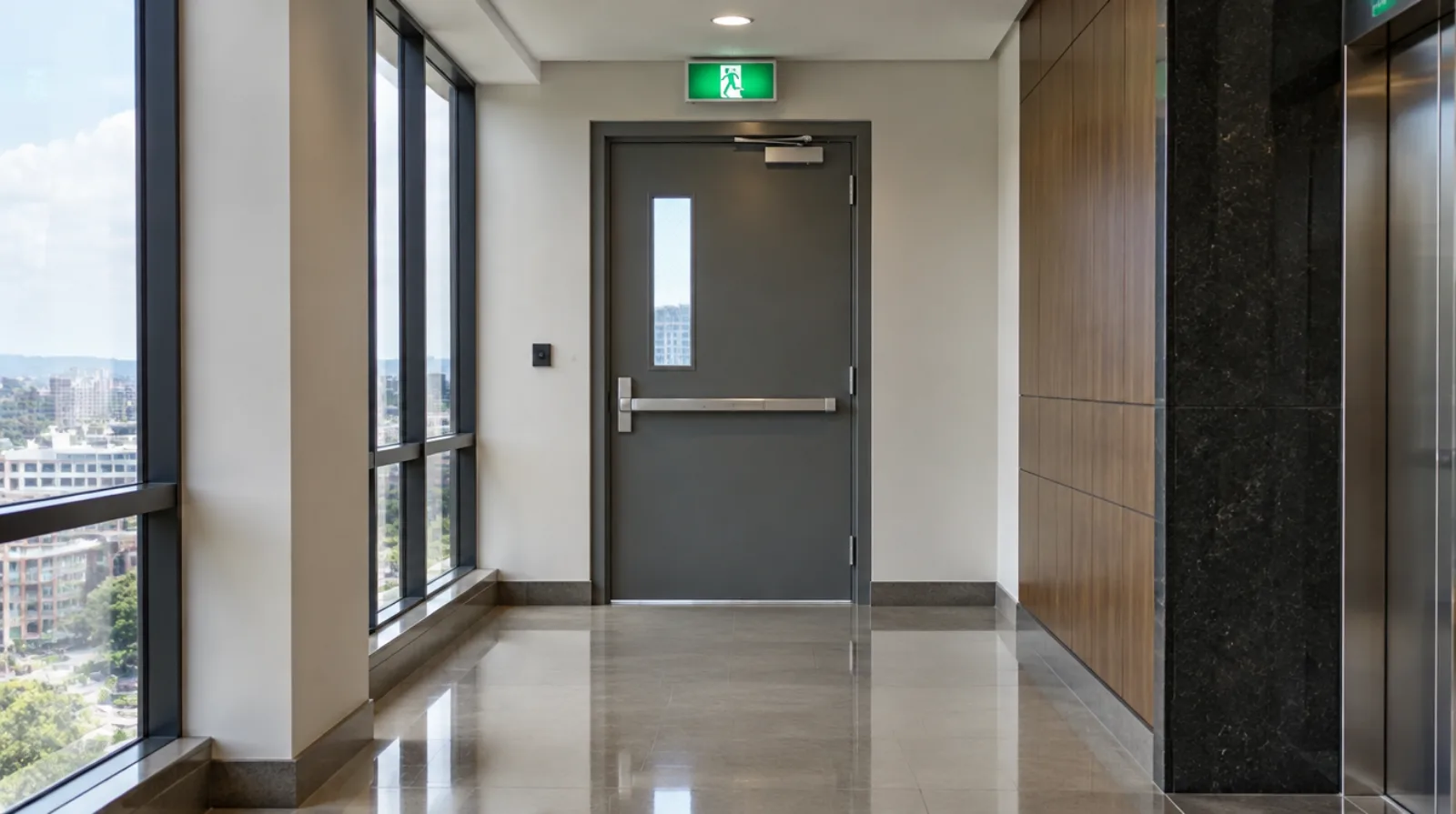
Fire Rated Doors Explained: What 60, 90 and 120 Minute Ratings Mean
A fire door’s rating is the number of minutes the complete door assembly held back fire in a standard furnace test: 60 minutes means it kept fire from passing through for one hour. The rating you need depends on the wall the door sits in and what is behind it. Corridors and room partitions often need 30 to 60 minutes, while stairwells, plant rooms and fire walls commonly need 90 to 120 minutes.
This guide explains what the numbers mean, which test standards to look for, and how to choose the right rating for a building in Uganda.
What does a fire door rating actually measure?
In a fire test, a complete door set (leaf, frame, hinges, seals, glass and hardware) is installed in a wall and exposed to a furnace that follows a standard time and temperature curve. The rating is how long the door stops flames and hot gases passing through before it fails.
That is why a fire door is only as good as its weakest part. A rated leaf in an ordinary frame, or with ordinary glass or hinges, is not a rated door.
30, 60, 90 or 120 minutes: where is each used?
| Rating | Typical locations | What it buys |
|---|---|---|
| 30 minutes | Doors between rooms and corridors in lower-risk areas; hazardous material cabinets | Time for people nearby to leave the area |
| 60 minutes | Corridors, offices, hotel rooms, hospital wards and room partitions | Time to evacuate a floor and protect escape routes |
| 90 minutes | Stairwells, lift lobbies and shafts in multi-storey buildings | Keeps vertical escape routes usable while a building empties |
| 120 minutes | Fire walls, generator and plant rooms, transformer and switch rooms, storage of flammable goods | Holds a serious fire inside its compartment for longer, protecting the rest of the building |
The exact rating for each opening is set by your building’s fire strategy and the approving authority. Your architect or fire consultant will mark it on the door schedule. As a general rule, a door gets a rating close to that of the wall it sits in.
Which test standards should a fire door meet?
Look for doors that are third-party tested, not just described as “fire resistant”. Common standards on Ugandan specifications include:
- UL 10C: an American test under positive pressure, which is closer to real fire conditions, followed by a hose stream test to check the door survives water and impact.
- NFPA 252: the matching US fire test method for door assemblies. NFPA 80 covers how fire doors are installed and maintained.
- BS 476 Part 22 and BS EN 1634-1: British and European fire resistance tests often named by consultants trained in the UK system.
MEK’s fire rated steel doors are third-party tested for 30 to 120 minutes to UL 10C and NFPA 252, and the UL Listed Fire Rated Steel Door comes as a UL-labelled door and frame assembly. Test certificates are available on request.
What makes a fire door hold for 60, 90 or 120 minutes?
- Galvanised steel faces and frame. MEK doors use galvanised steel for the leaf and frame, with a reinforced sub-frame inside the leaf.
- A fire-resistant core. Rockwool or honeycomb infill between the steel faces slows heat passing through.
- Smoke seals. Smoke kills more people than flames. MEK doors come with pre-fitted smoke seals.
- Fire-rated glass. Vision panels use 8 mm, 180-minute fire-rated glass, so a panel never becomes the weak point.
- Rated hinges and hardware. Hinges, closers and panic bars must suit fire doors. MEK supplies EN 1125 panic hardware for exit routes.
Do you need a fire exit door or a fire rated door?
They solve different problems, and many buildings need both.
- A fire rated door keeps fire and smoke inside a compartment, such as the Fire Rated Steel Door MEK-1005 for stairwells, plant rooms and corridors.
- A fire exit door is on an escape route and must open outward from the inside with a single push, without keys. The Fire Exit Door MEK-1008 combines both: it is fire rated and takes panic bars.
How do you keep a fire door working?
A fire door only works when it is closed. Never wedge it open, keep the self-closer adjusted so the door shuts fully, check the smoke seals for damage, and don’t drill or fit hardware that wasn’t supplied for a fire door.
Fire doors made by MEK since 1921
MEK has made steel doors since 1921. MEK Uganda supplies single and double fire doors, matching frames and hardware, delivered and installed across Uganda and East and Central Africa. Our team can also help plan door ratings and locations through our Fire & Life Safety System Design service. Browse the full Fire & Safety range.
Frequently Asked Questions
What does a 60 minute fire door rating mean?
It means the complete door assembly stopped fire passing through for at least 60 minutes in a standard furnace test. It doesn't mean the door is undamaged after 60 minutes.
Can a fire door have glass in it?
Yes, if the glass is fire rated. MEK fire doors use 8 mm, 180-minute fire-rated glass in their vision panels.
What is the difference between UL 10C and BS 476?
UL 10C is an American fire test run under positive pressure and followed by a hose stream test. BS 476 Part 22 is the older British test. Both measure how long a door holds back fire; your consultant's specification will say which one is required.
Do fire doors have to be steel?
No, but steel fire doors suit commercial and industrial buildings in Uganda because they resist impact, humidity and termites, and galvanised steel holds up in external openings.
Can you supply test certificates?
Yes. Test certificates and technical data sheets for MEK fire doors are available on request.
Have a door schedule from your architect?
Send it to MEK Uganda and we will match each opening to the right fire rated door.